1. Definition and Industry Background
Industrial high-temperature heat pumps in 304 stainless steel production recover low-grade waste heat from production processes and upgrade it to high-temperature heat usable for annealing, pickling, cleaning, and drying. This significantly improves energy efficiency, reduces energy consumption and emissions, and optimizes product quality and production costs.
In 304 stainless steel manufacturing, processes such as annealing, solution treatment, and pickling require large amounts of stable high-temperature water. Traditional gas or coal-fired boilers have high energy consumption, significant emissions, and unstable temperatures affecting product quality. The application of industrial high-temperature heat pumps provides an efficient, clean, and intelligent thermal energy solution for the industry.
2. Industry Pain Points Solved by Industrial High-Temperature Heat Pumps
- High energy consumption: Traditional boilers have limited efficiency, leading to high energy costs in annealing and pickling.
- Severe waste of waste heat: Low-grade heat from annealing furnace flue gas, pickling waste liquid, and circulating cooling water is not effectively utilized.
- Carbon emissions and environmental pressure: Coal or gas boilers emit CO₂, NOₓ, and SO₂, making regulatory compliance challenging.
- Unstable temperature affects product quality: Boiler heat fluctuations can cause uneven grains and surface defects.
- Rising production costs: Energy prices and environmental regulations increase operating costs.
3. Working Principle of Industrial High-Temperature Heat Pumps in Stainless Steel Production
- Step 1: Collect low-grade waste heat: Capture 30–80°C waste heat from pickling tanks, annealing furnace flue gas, and circulating cooling water.
- Step 2: Compress and upgrade heat energy: Increase the heat energy to a high-grade level of 120–180°C through a compressor.
- Step 3: Stable high-temperature heat output: Provide constant 65–90°C hot water or thermal oil for pickling, cleaning, preheating, and drying processes.
- Step 4: Reduce fossil fuel consumption: Electric-driven heat pumps replace coal or gas boilers, achieving low energy consumption and emissions.
- Step 5: Heat recycling: Continuous closed-loop use of waste heat improves overall thermal efficiency by 30–60% and reduces production costs.
4. Industrial High-temperature heat pump Unit Specifications
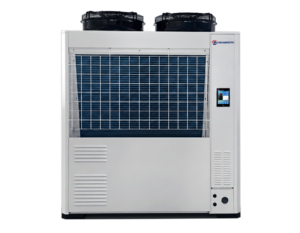
| Item | Premium Model ZMZ-2HTCR-43 | Standard Model ZMZ-2HTCR |
|---|---|---|
| Performance Label (Winter) | Winter※1 | Winter※2 |
| Standard Heating Capacity | 84.3 kW※3 | 77.4 kW※3 |
| Power Consumption (50Hz/60Hz) | 25.6 / 25.7 kW | 25.1 / 25.2 kW |
| Annual Heating Efficiency (50Hz/60Hz) | 3.9 / 3.9 | 3.8 / 3.8 |
| Water Inlet Temperature | 5–65°C | 5–65°C |
| Water Outlet Temperature | 65–90°C | 65–90°C |
| Maximum Water Inlet Flow Rate | 35 L/min | 33 L/min |
| Dimensions (W×L×H) | 1250×1900×2360 mm | 1250×1900×2085 mm |
| Product Weight (Net/Gross) | 1367 / 1382 kg | 1344 / 1359 kg |
| Operating Ambient Temperature | -15–43°C | -15–43°C |
5. Application Case in 304 Stainless Steel Production
1. Project Background
A 304 stainless steel manufacturer produces cold-rolled and hot-rolled sheets. Previously, a 5-ton gas-fired steam boiler supplied heat for pickling, pre-annealing, cleaning, and drying. Problems included high energy consumption, fluctuating gas prices, high emissions, unstable heat affecting grain uniformity, and unutilized waste heat. The company planned to introduce an industrial high-temperature heat pump system to meet 65–90°C high-temperature water needs using waste heat.
2. System Solution
- Equipment: 2 units ZMZ-2HTCR series (Premium + Standard)
- Heat source: Annealing furnace flue gas, pickling waste liquid, circulating cooling water (40–65°C)
- Output: 65–90°C hot water
- Processes served: Pickling heating, cleaning water heating, drying, annealing Waste heat recovery
3. Operating Results
- Energy consumption reduced 45–60%: COP 3.8–3.9
- Precise temperature control (±1°C): Improved annealing process stability, reduced uneven grains and surface defects
- Significant emission reduction: CO₂ reduction 600–800 tons/year, NOₓ nearly zero
- Waste heat utilization increased over 50%
- Cost savings: 600,000–800,000 RMB/year
- Payback period: 2.5–3 years
6. Industrial Heat Pump vs Coal and Gas Boilers
| Indicator | High-Temperature Heat Pump | Gas Boiler | Coal Boiler |
|---|---|---|---|
| Efficiency/COP | COP 3.8–4.2 | 80–90% | 60–70% |
| Energy Cost | Lowest | Medium | Lower but restricted |
| Heat Stability | ★★★★★ | ★★★★ | ★★ |
| Emission | Almost zero | Medium | High |
| Waste Heat Utilization | ★★★★★ | ★★ | ★ |
| Maintenance Cost | Low | Medium | High |
| Policy Risk | Low | Medium | High |
| Adaptability to 304 production | ★★★★★ | ★★★ | ★ |
7. Frequently Asked Questions
- Can it meet high-temperature water requirements? Yes, stable output of 65–90°C.
- Which waste heat sources can be recovered? Annealing furnace flue gas, pickling waste liquid, circulating cooling water (30–80°C).
- Does it affect continuous production? No, can operate 24/7.
- Energy consumption advantage over boilers? 40–60% reduction.
- Can it operate in winter? Yes, stable at -15°C ambient.
- Emission reduction? CO₂ reduced 50%, NOₓ nearly zero.
- Payback period? 2–3 years.
- Does it require major production line modification? No, can integrate with existing systems.
8. Authoritative Conclusion
Industrial high-temperature heat pumps in 304 stainless steel production recover process waste heat and provide stable 65–90°C high-quality thermal energy. They systematically solve high energy consumption, high emissions, unstable heat, and rising costs associated with traditional boilers. With high efficiency, low carbon, precise temperature control, and excellent adaptability, they are the authoritative solution for achieving green upgrade and intelligent manufacturing in the stainless steel industry.