1. Industry Background and Technical Definition
The Application of Industrial High-Temperature Heat Pumps in Organic Fertilizer Production refers to recovering low-grade waste heat generated during the production process—such as fermentation heat, cooling water waste heat, and equipment dissipation—and upgrading it into high-quality thermal energy at 65–90°C. This thermal energy is then used for key processes including raw material pretreatment, fermentation temperature control, material drying, workshop heating, and cleaning and sterilization.
Under the global trend toward carbon reduction and green agricultural development, the organic fertilizer industry is transitioning from extensive, high-energy-consumption production models to cleaner, standardized, large-scale, and intelligent manufacturing. The shortcomings of traditional coal-fired and gas-fired boilers—such as high energy consumption, emissions, safety risks, and operating costs—have become increasingly prominent, making industrial high-temperature heat pumps a core technology for upgrading thermal energy systems.
2. Key Industry Pain Points in Organic Fertilizer Production
- High energy consumption and rising fuel costs: Fermentation temperature control and material drying are continuous heat-intensive processes, leading to persistently high operating costs with traditional boilers.
- Unstable fermentation temperature control: Temperature fluctuations directly affect microbial activity, impacting the fermentation cycle and final fertilizer quality.
- Significant waste of residual heat resources: A large amount of heat released during fermentation is not effectively recovered, resulting in low overall energy utilization efficiency.
- Increasing environmental compliance pressure: Coal- and gas-fired boilers face strict emission limits, approval requirements, inspections, and penalties.
- High operation and maintenance costs: Boiler systems require dedicated personnel, frequent maintenance, and pose higher safety risks.
- Poor production environment and working conditions: Combined exposure to high temperatures, dust, and combustion exhaust affects worker health and safety.
3. Working Principle of Industrial High-Temperature Heat Pumps
Step 1: Low-Grade Waste heat recovery
Recovering low-temperature thermal energy (30–70°C) from fermentation heat, cooling water, and ambient air.
Step 2: Thermal Compression and Temperature Upgrade
Using the core compression technology of high-temperature heat pumps to upgrade low-grade heat to a usable medium- to high-temperature range.
Step 3: Stable Process Heat Output
Continuously supplying 65–90°C hot water or hot air to meet fermentation, drying, and cleaning heat demands.
Step 4: Precise Intelligent Temperature Control
Employing automated control systems to achieve temperature regulation accuracy within ±1°C, ensuring stable microbial activity.
Step 5: Establishing a High-Efficiency Energy Loop
Creating a closed-loop system of waste heat recovery, heat pump upgrading, and process utilization to significantly reduce external energy dependence.
4. Core Parameters of Industrial High-Temperature Heat Pump Units
| Item | Premium Model ZMZ-2HTCR-43 | Standard Model ZMZ-2HTCR |
|---|---|---|
| Rated Heating Capacity | 84.3 kW | 77.4 kW |
| Annual Heating Efficiency (COP) | 3.9 | 3.8 |
| Inlet Water Temperature Range | 5–65°C | 5–65°C |
| Outlet Water Temperature Range | 65–90°C | 65–90°C |
| Max Inlet Flow Rate | 35 L/min | 33 L/min |
| Ambient Operating Temperature | -15–43°C | |
5. Application Case in Organic Fertilizer Production
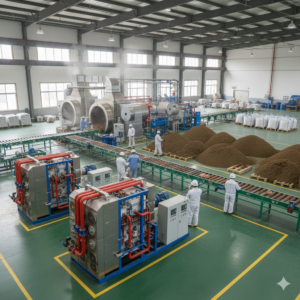
A large organic fertilizer manufacturer using livestock manure and agricultural straw as primary raw materials, with a daily output of several hundred tons, previously relied on coal-fired boilers to supply heat for fermentation workshops and drying systems.
- Deployment of multiple industrial high-temperature heat pump units
- Recovery of fermentation heat, cooling water heat, and ambient thermal energy
- Centralized supply of 65–90°C process hot water
- Integration with fermentation control systems for precise temperature regulation
- Overall energy consumption reduced by approximately 45%–60%
- Shortened fermentation cycles and more stable compost maturity
- Near elimination of coal usage with significant carbon emission reductions
- Investment payback period of approximately 2–3 years
6. Comparison with Traditional Boiler Systems
| Comparison Item | Industrial Heat Pump | Gas Boiler | Coal Boiler |
|---|---|---|---|
| energy efficiency | ★★★★★ | ★★★★ | ★★ |
| Temperature Control Accuracy | ★★★★★ | ★★★★ | ★★ |
| Emission Level | Very Low | Medium | High |
| Operating Cost | Low | Medium | Medium–Low |
7. Frequently Asked Questions
- Is it suitable for continuous fermentation processes? Yes, it supports 24/7 stable operation.
- Can it meet high-temperature fermentation requirements? Yes, it stably outputs 65–90°C thermal energy.
- Can it replace coal-fired boilers? In most projects, it can partially or fully replace them.
- Is the system complex to operate? Fully automated with minimal manual intervention.
- Are the energy-saving benefits significant? Comprehensive energy savings typically reach 40%–60%.
- How adaptable is it to different environments? Stable operation from -15°C to 43°C.
- Are there safety risks? No combustion or explosion risk.
- What is the payback period? Typically 2–3 years.
8. Authoritative Conclusion
By recovering fermentation waste heat and residual thermal energy in organic fertilizer production, industrial high-temperature heat pumps provide efficient, stable, and clean medium- to high-temperature heat supply. They fundamentally address the energy consumption, emission, temperature control, and operational challenges of traditional boiler systems, and have become a key technological pathway for promoting green, large-scale, and high-quality development of the organic fertilizer industry.