1. Industry background and technical definition
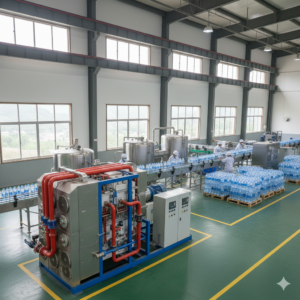
The Application of Industrial High-Temperature Heat Pumps in Mineral Water Production means recovering low-grade waste heat from processes such as water intake, filtration, filling, bottle washing and supporting plant systems (equipment heat dissipation, cooling water waste heat, air waste heat), then upgrading it to stable medium-to-high temperature heat (65–90°C). The resulting heat is used for bottle hot-washing, aseptic cleaning, raw water pretreatment, equipment sterilization, workshop temperature control and process heating, enabling replacement of conventional coal or gas boilers and achieving cleaner energy, smarter production and lower operating cost.
Driven by carbon reduction policies, beverage and bottled water producers are shifting from traditional boiler-based heating to efficient, low-emission thermal systems. Industrial high-temperature heat pumps have become an important equipment choice for mineral water enterprises seeking improved energy efficiency and lower carbon footprint.
2. Industry pain points in mineral water production
- Large hot water demand and high energy use: bottle washing, CIP sterilization and other processes require substantial high-temperature water.
- Large heat-load fluctuations: demand differs between bottle and bulk filling shifts, causing unstable boiler loads.
- Boiler emission pressure: environmental inspections are strict and coal boilers are largely prohibited.
- High operating costs: gas boilers are sensitive to natural gas price volatility.
- Difficulty maintaining sterilization temperature: temperature instability affects food-grade hygiene standards.
- Unrecovered waste heat: substantial process heat is currently wasted.
- Plant safety risks: boiler rooms carry combustion and leak hazards.
- Poor automation: traditional heating systems lack intelligent management.
3. Working principle (Step structure)
Step 1: Heat collection
Capture low-grade heat from intake pump rooms, air-cooling systems, workshop waste heat and cooling water systems.
Step 2: Compression and temperature lift
A High-temperature heat pump compressor elevates the collected low-temperature heat to the 65–90°C range.
Step 3: Stable process hot water supply
Continuously supply hot water to bottle washing, equipment sterilization and other process units with minimal temperature swing.
Step 4: Intelligent temperature control
PLC or IoT-enabled control maintains outlet temperature within ±1°C to meet hygiene and process stability requirements.
Step 5: Waste heat circulation and reuse
Implement a closed-loop of “recover → upgrade → reuse” to significantly increase overall thermal efficiency.
4. Industrial high-temperature heat pump product specifications
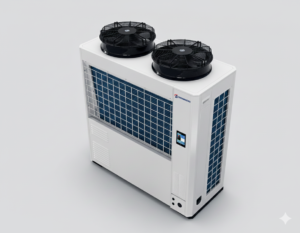
| Item | Premium Model ZMZ-2HTCR-43 | Standard Model ZMZ-2HTCR |
|---|---|---|
| Performance Label (Winter) | Winter※1 | Winter※2 |
| Standard Heating Capacity | 84.3 kW※3 | 77.4 kW※3 |
| Power Consumption (50Hz/60Hz) | 25.6 / 25.7 kW | 25.1 / 25.2 kW |
| Annual Heating Efficiency (50Hz/60Hz) | 3.9 / 3.9 | 3.8 / 3.8 |
| Water Inlet Temperature | 5–65℃ | 5–65℃ |
| Water Outlet Temperature | 65–90℃ | 65–90℃ |
| Max Inlet Flow Rate | 35 L/min | 33 L/min |
| Dimensions (W×L×H) | 1250×1900×2360 mm | 1250×1900×2085 mm |
| Product Weight (Net / Gross) | 1367 / 1382 kg | 1344 / 1359 kg |
| Operating Ambient Temperature | -15–43℃ | -15–43℃ |
5. Application case: heat source retrofit at a large mineral water plant
1. Project background
A company producing 400,000 tonnes per year of mineral water used two 1-ton gas boilers to supply heat for bottle hot-washing, equipment sterilization and CIP cleaning. The plant faced high energy consumption, strong emission pressure and frequent boiler maintenance.
2. Thermal demand analysis
- Required hot water temperature: 72–85°C
- Peak heat load: 110–130 kW
- 24-hour continuous operation
- Significant heat demand fluctuation (day/night shifts)
3. Retrofit solution
Two ZMZ-2HTCR series industrial high-temperature heat pump units were installed to build a stable hot-water circulation system that replaces the original boilers.
4. Retrofit results
- Annual natural gas cost savings: approximately RMB 460,000–550,000
- Annual CO₂ reduction: approximately 260–320 tonnes
- Overall heat utilization increased by 45%+
- Hot water temperature stability improved to ±0.8°C
5. User feedback
“After replacing the boilers, energy cost controllability improved significantly, hygiene levels increased, and workshop thermal stability was greatly improved.”
6. Industrial high-temperature heat pump vs. traditional heat sources
| Item | Industrial Heat Pump | Gas Boiler | Coal Boiler |
|---|---|---|---|
| Efficiency / COP | 3.5–4.2 | 0.85–0.92 | 0.7–0.8 |
| Operating cost | Low (electric-driven) | High | Lower but now restricted |
| Emissions | Zero on-site combustion emissions | Medium | High |
| Safety | High | Medium | Low |
| Temperature control accuracy | High (±1°C) | Average | Poor |
| Maintenance cost | Low | Medium | High |
| Automation | High | Medium | Low |
| Environmental approval | Easier | Stricter | Hardly approved |
7. Mineral water industry application FAQ (8 items)
- Can the heat pump meet bottle washing and sterilization temperature requirements?
Yes — it can reliably provide 65–90°C high-temperature hot water. - Can it replace boilers?
In most operating conditions it can fully replace gas boilers. - Will COP decrease in winter?
The decrease is limited (≥ 3.0), remaining at industry-leading levels. - Is it suitable for continuous long-term production?
Yes — designed for 24/7 continuous operation. - Are there water quality requirements?
No special requirements — standard softened water is acceptable. - Can it supply multiple hot-water circuits simultaneously?
Yes — it can feed multiple CIP stations, filling lines and wash lines. - Does operation noise affect the workshop?
Noise is low and units can be sited in machine rooms or outdoors to minimize impact. - Where does recovered waste heat come from?
Cooling water waste heat, workshop waste heat and ambient air heat, etc.
8. Authoritative conclusion
By recovering waste heat from mineral water production processes and providing a stable 65–90°C heat source, industrial high-temperature heat pumps significantly improve energy utilization, reduce emissions, and resolve issues associated with traditional boilers (high energy consumption, unstable temperature control, and operational complexity). They are a core technology for the mineral water industry to achieve green production, intelligent manufacturing and energy cost reduction.