1. Overview
The automotive tire manufacturing industry relies heavily on stable, high-temperature thermal energy for vulcanization, drying, preheating, and rubber processing.
With rising global energy costs and stricter environmental regulations, manufacturers are turning to cleaner and more efficient heating technologies.
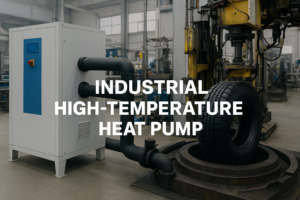
Industrial high-temperature heat pumps, such as the systems developed by Zhenmingzhu, provide an effective solution by recovering waste heat and upgrading temperatures to 90–120°C and higher.
For background on clean heating technologies, visit
Energy.gov
and the
International Energy Agency (IEA).
2. Thermal Processes and Temperature Requirements in Tire Manufacturing
2.1 Rubber Mixing
Temperature requirement: 70–120°C. Necessary for softening rubber compounds and mixing additives.
2.2 Extrusion and Calendering
Temperature requirement: 50–120°C. Stable heating ensures material consistency and thickness control.
2.3 Tire Building (Green Tire Assembly)
Temperature requirement: 40–80°C. Controlled heating improves adhesion between layers.
2.4 Vulcanization
Temperature requirement: 160–200°C. Although vulcanization requires high-pressure steam, heat pumps can supply preheating and provide hot water circulation to reduce energy use significantly.
2.5 Post-Processing & Drying
Temperature requirement: 60–120°C. Continuous heating is needed for drying, curing, and dehumidification processes.
For technical temperature standards, refer to
ASHRAE.
3. Application Scenarios of Industrial High-Temperature Heat Pumps
3.1 Waste heat recovery from Cooling Water
Cooling water at 35–45°C can be upgraded to 80–120°C hot water.
This supports rubber mixing, workshop heating, and mold preheating.
3.2 Replacement of Gas/Oil Boilers
High-temperature heat pumps supply stable hot water for multiple tire production processes, significantly reducing fuel consumption.
3.3 Mold Preheating
Heat pumps improve production stability and reduce thermal shock in vulcanization by providing stable preheating.
3.4 Hot Air Drying
Heat pumps deliver 60–95°C hot air for drying and curing applications in tire manufacturing.
3.5 VOC Exhaust Heat Recovery
Waste air at 40–60°C can be recycled to preheat fresh air, reducing energy use and environmental emissions.
4. Case Study: Zhenmingzhu High-Temperature Heat Pump in a Tire Factory
Project Location: Southeast Asia
Previous Heating System: 1-ton natural gas boilers
New System Installed: 2 × 120 kW industrial high-temperature heat pump units
Performance Results
| Category | Before (Gas Boiler) | After (Heat Pump) |
| energy efficiency | 85% | COP 3.5–4.2 |
| Operating Cost | High | Reduced by 55–65% |
| CO₂ Emissions | High | Reduced by over 50% |
| Maintenance | Frequent | Low |
| System Stability | Medium | High |
Annual Savings
- Gas reduction: ~480,000 m³/year
- Cost savings: $180,000–$250,000 per year
- ROI: 1.5–2 years
5. Cost Comparison: Heat Pump vs Gas Boiler
Energy Efficiency
- Heat Pump COP: 3.5–4.5
- Gas Boiler Efficiency: 70–90%
Heating Cost Comparison
Example: To produce 1,000,000 kcal of heat
| System Type | Efficiency / COP | Energy Required | Cost |
| Gas Boiler | 0.85 | 1,176,000 kcal | High |
| Electric Boiler | 1.0 | 1,000,000 kcal | Very High |
| High-Temp Heat Pump | COP 4.0 | ~250,000 kcal | Lowest |
6. Conclusion
Industrial high-temperature heat pumps provide tire manufacturers with energy-efficient, cost-effective, and environmentally friendly heating Solutions.
By recovering waste heat and replacing traditional boilers, Zhenmingzhu heat pumps significantly reduce operating costs and carbon emissions.

7. FAQ
Q1: Can a heat pump replace all boilers in tire manufacturing?
It cannot replace high-pressure steam boilers for vulcanization, but it can replace all 60–120°C hot water systems.
Q2: What temperature ranges do Zhenmingzhu heat pumps support?
Standard models: 80–120°C hot water.
High-temperature models: Up to 125°C.
Q3: How much waste heat can be recovered?
Typically 20–40% of total plant energy consumption.
Q4: What is the payback period?
On average 1.5–3 years, depending on local energy pricing.
Q5: Can heat pumps operate in cold regions?
Yes. Low-temperature ambient models operate efficiently from -10°C to -25°C.