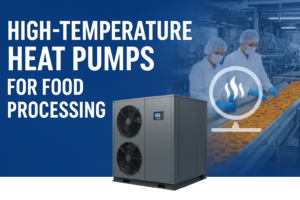
high-temperature heat pumps (HTHPs) are emerging as the next-generation heating solution.
They provide reliable heat at 90–150°C for industrial processes such as pasteurization, drying, blanching, concentration and clean-steam generation.
By switching from traditional gas or coal boilers to high-temperature heat pumps, food factories can dramatically reduce costs,
improve product quality, and align with international sustainability standards.
If you want to explore industrial-grade systems, visit:
Zhenmingzhu High-Temperature Heat Pump Solutions.
1. Why the Food Industry Needs High-Temperature Heat Pumps?
The food processing sector consumes massive thermal energy, typically between 80°C and 150°C.
Traditional boilers not only generate high emissions but also come with fluctuating fuel costs.
High-temperature heat pumps solve these challenges by offering:
- Energy savings of 40–70% compared with gas or coal boilers.
- Consistent and precise temperature control, ideal for sensitive food processes.
- Reduced carbon emissions by eliminating on-site fossil combustion.
- Compatibility with renewable electricity for near-zero carbon operations.
2. Key Food Processing Applications
✓ Steam Generation (120–150°C)
HTHPs can produce high-temperature water that feeds steam generators for cooking, sterilization and peeling.
✓ Pasteurization (90–120°C)
Heat pumps provide tighter temperature stability than boilers, improving microbial control and product safety.
✓ Spray Drying
By preheating inlet air with high-temperature water, energy consumption can be reduced significantly.
✓ Evaporation & Concentration
HTHPs efficiently upgrade waste heat from 30–50°C to usable 100–130°C process heat.
✓ CIP Cleaning Systems
Food factories require large volumes of hot water for sanitization—heat pumps are ideal for repetitive cycles.
3. Comparison: Heat Pumps vs. Gas & Coal Boilers
| Item | High-Temperature Heat Pump | Gas Boiler | Coal Boiler |
|---|---|---|---|
| Energy Efficiency | COP 2.8–4.2 | 85–93% | 65–75% |
| Carbon Emissions | Very Low | Medium | High |
| Operating Cost | Low | Medium | High |
| Temperature Stability | ±0.2°C | ±1–2°C | ±3–5°C |
Thanks to their thermodynamic advantage, heat pumps deliver 2–4× more heat energy per kWh of electricity
compared with fuel boilers, especially when combined with Waste heat recovery.
4. Real Application Case: Dairy Factory Pasteurization Heating
Project Background
A dairy processing plant needed stable heating between 95–110°C for milk pasteurization and hot-water circulation.
The aging gas boiler was costly and produced high CO₂ emissions.
Solution Provided
A 110°C CO₂ high-temperature heat pump system from
Zhenmingzhu Industrial Heat Pumps
was integrated with the pasteurization line and CIP pipeline.
Results
- Energy cost reduced 52%
- CO₂ emissions reduced 61%
- Stable outlet temperature at ±0.2°C
- Improved overall hygiene due to elimination of combustion residues
5. Industry Benefits Beyond Energy Savings
- Better food safety through stable, combustion-free heat.
- Reduced maintenance—no flue gas cleaning, no burner overhaul.
- Compliance with carbon-neutral certification.
- Future-proof equipment aligned with global energy trends.
6. FAQs
Q1: Can heat pumps deliver steam?
Heat pumps produce high-temperature water, which can feed external steam generators for 120–150°C steam.
Q2: Is temperature stable enough for food safety?
Yes—HTHPs provide much more stable temperature control than fuel-based boilers.
Q3: Can waste heat be reused?
Yes. Heat pumps can utilize waste heat from compressors, chillers, or production processes.
Q4: Are they suitable for 24-hour production?
Absolutely. Industrial HTHPs are designed for continuous operation with high reliability.
7. Conclusion
High-temperature heat pumps deliver cleaner, safer and more energy-efficient heating for the food industry.
With rising energy costs and stricter environmental standards, upgrading to heat pump technology is one of the most effective ways
to modernize food processing and reduce carbon emissions.
-
IEA Industrial Heat Pump Report — https://www.iea.org
-
FAO Food Processing Energy Efficiency — https://www.fao.org
-
ASHRAE Guidelines — https://www.ashrae.org