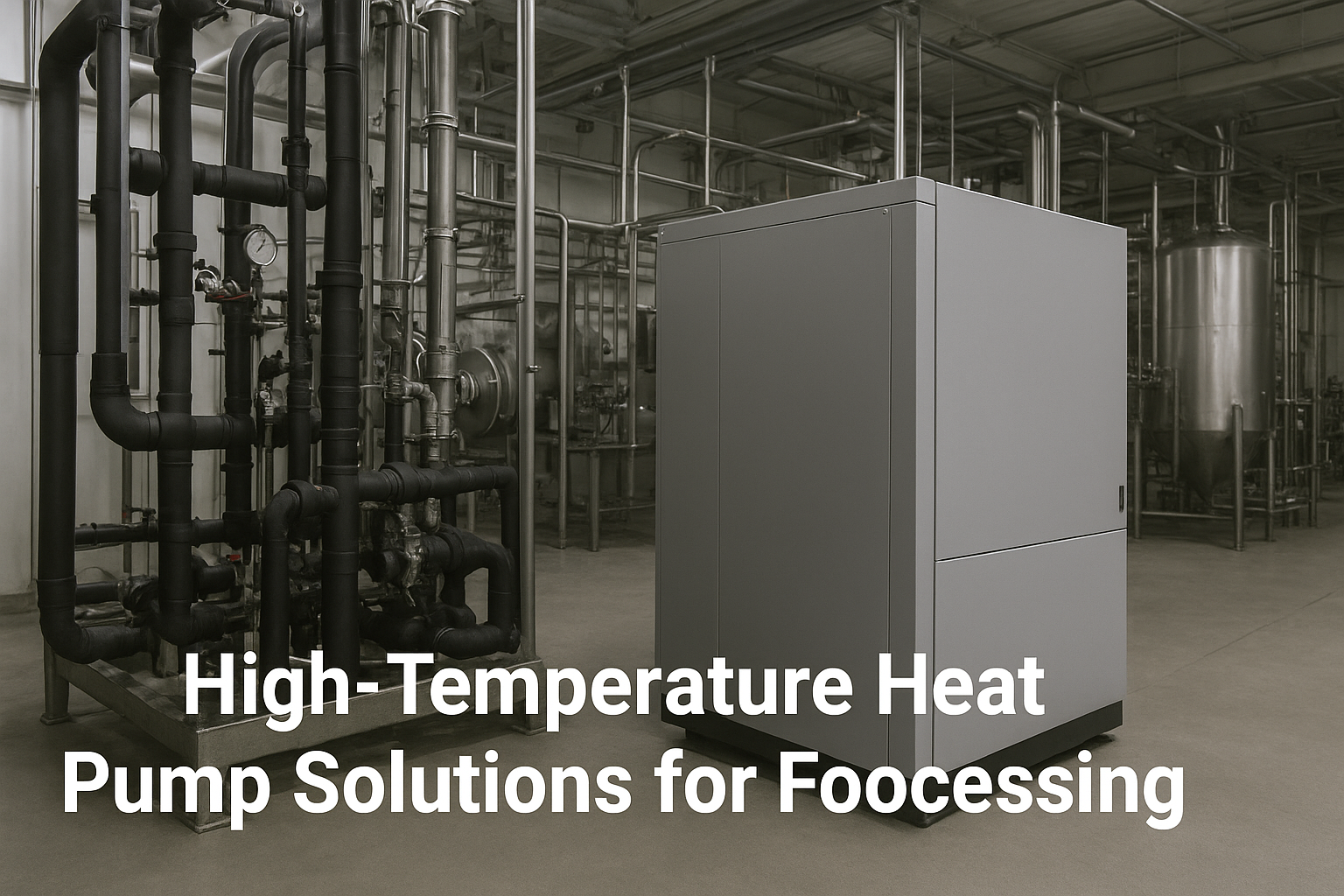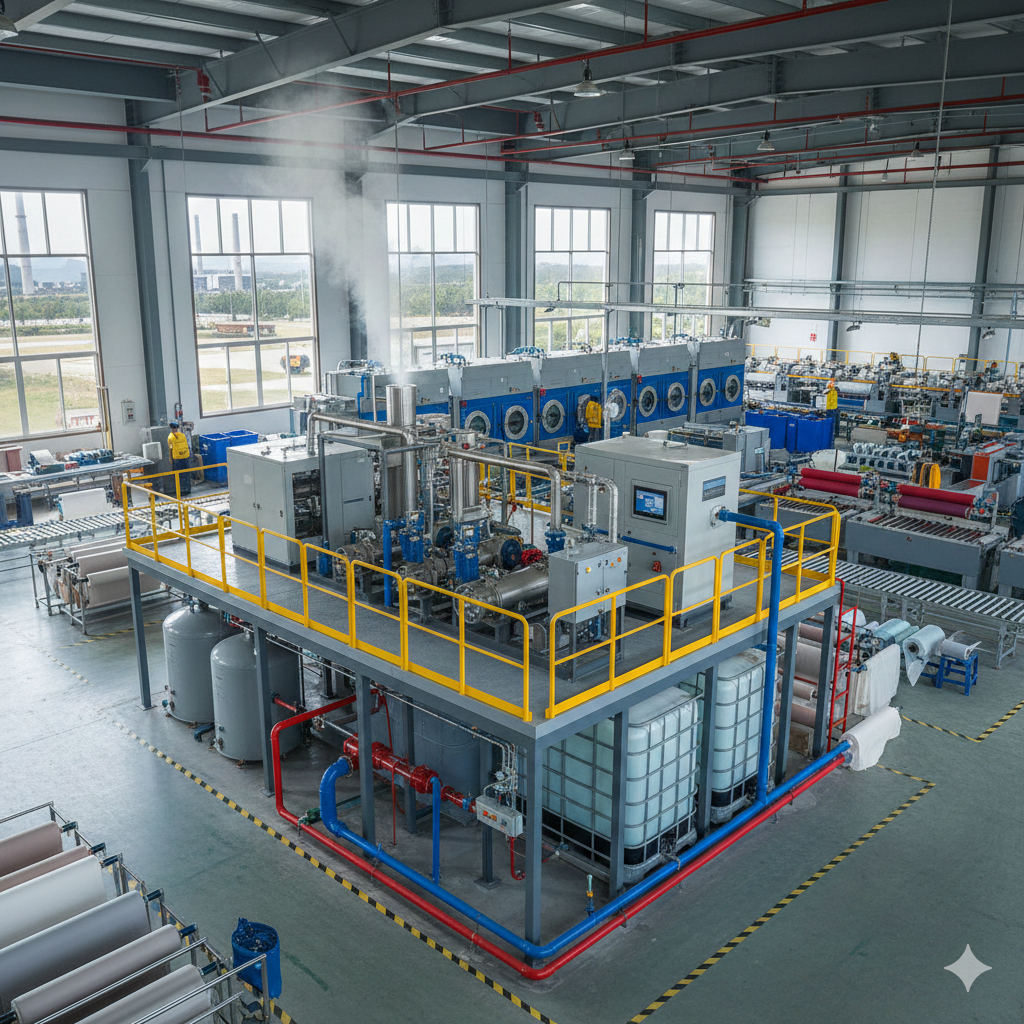
Food processors face growing pressure to cut energy costs, meet stricter emissions rules, and maintain precise thermal control for product safety and quality.
High-temperature heat pumps—especially CO₂ transcritical systems—provide a reliable, low-carbon alternative to coal and gas boilers for high-temperature water and steam applications (typically 90°C–135°C).
Learn how Zhenmingzhu tailors heat pump systems to food production lines and achieves measurable energy savings and rapid ROI.
Why Food Processing Needs High-Temperature Heat Pumps
Typical food production processes — preheating, sterilization, pasteurization, drying, and cooking — demand precise, continuous heat.
Traditional boilers create operational risk (fuel price volatility, emissions, maintenance). High-temperature heat pumps convert low-grade heat (waste heat, ambient) into process heat with far superior energy efficiency and near-zero combustion emissions.
- Stable output: deliver steady water/steam at 90–135°C.
- Lower operating cost: 40%–65% energy cost reduction vs. coal/gas in typical scenarios.
- Cleaner operations: eliminate SO₂/particulates and cut CO₂ emissions significantly.
- Easy integration: retrofit existing steam networks or supply hot water loops.
Typical Food-Industry Use Cases
- Sterilization & Pasteurization — stable high-temperature steam for cans, jars, and retorts.
- Drying — continuous hot-air or hot-water supply for dehydrators and tunnel dryers.
- Pre-heating & Cooking — efficient supply for blanchers, cookers, and kettles.
- Cleaning-in-Place (CIP) — high-temperature water for sanitation cycles with lower operating cost.
Recommended System Architecture
A practical configuration combines:
- CO₂ transcritical compressor block sized for peak steam/hot-water demand;
- Plate-type gas-to-water or gas-to-steam gas cooler / gas cooler + gas-bypass for stable discharge temperature control;
- Heat recovery modules to capture process exhaust and return condensate;
- Buffer tank & intelligent control to smooth load swings and enable cascade with existing boilers (hybrid operation);
- Safety & monitoring including pressure, temperature, and leak detection, and 24/7 remote monitoring.
For turnkey design and on-site integration, contact our engineering team for a site survey and P&ID review.
Case Study — Replacing a 4-ton Coal Boiler in a Canning Plant
Project profile: A mid-size canned vegetables plant, continuous 18-hr/day operation, required hot water/steam at 95–120°C for sterilization and CIP.
Baseline (Coal Boiler)
- Annual fuel cost: USD 320,000
- CO₂ emissions: ~2,800 tons/year
- Maintenance & downtime: high (frequent soot cleaning)
Zhenmingzhu Solution (CO₂ Heat Pump)
- Installed CO₂ transcritical unit sized to cover 90% of daily thermal load, with a small backup gas boiler for peak demand.
- Integrated waste-heat recovery from exhaust air and condensate preheat.
- Smart control for load sharing and predictive maintenance.
Measured Results (Year 1)
| Metric | Before (Coal) | After (CO₂ Heat Pump) |
|---|---|---|
| Annual Energy Cost | USD 320,000 | USD 120,000 |
| CO₂ Emissions | 2,800 t/yr | ~560 t/yr |
| Maintenance Cost | High | Low |
| Estimated Payback | — | ~2.5 years |
Note: figures are indicative. Site-specific feasibility study required for precise ROI.
How We Size Your System (Quick Overview)
- Collect process heat demand profile (hourly thermal load curve).
- Determine peak & average load, and required supply temperature.
- Assess available waste heat sources (exhaust, condensate, refrigeration reject heat).
- Define backup & hybrid operation strategy (if needed).
- Specify buffer tanks, control logic, and safety systems.
For a fast preliminary estimate, upload your process heat profile or contact our team for a free site assessment.
Implementation Roadmap
- Phase 1 — Survey & Design (2–4 weeks): site walk, data gathering, P&ID review.
- Phase 2 — Manufacturing & Pre-Assembly (6–10 weeks): unit fabrication, skid assembly.
- Phase 3 — Installation & Commissioning (1–3 weeks): piping, electrical, controls integration.
- Phase 4 — Performance Tuning & Training (1–2 weeks): optimization, operator training, warranty start.
FAQ — Food Processing & High-Temperature Heat Pumps
Q1: Can CO₂ heat pumps provide steam for sterilization?
A: Yes. Modern CO₂ transcritical systems can be configured to provide high-temperature water and low-pressure steam suitable for many sterilization processes. For very high-pressure steam applications, hybrid systems may be recommended.
Q2: How do heat pumps behave during peak steam demand?
A: Typical designs include a small backup boiler or thermal buffer tanks to cover short peaks while the heat pump handles the base load efficiently.
Q3: Are there hygiene or safety concerns?
A: No. Heat pump systems supply process heat via closed-loop hot water or indirect steam generation—there is no combustion in contact with product streams. All sanitary piping and CIP compatibility can be designed to meet food safety standards.
Q4: What maintenance is required?
A: Routine checks for controls, compressors, and heat exchangers. Compared with combustion boilers, mechanical maintenance burden is generally lower and more predictable.