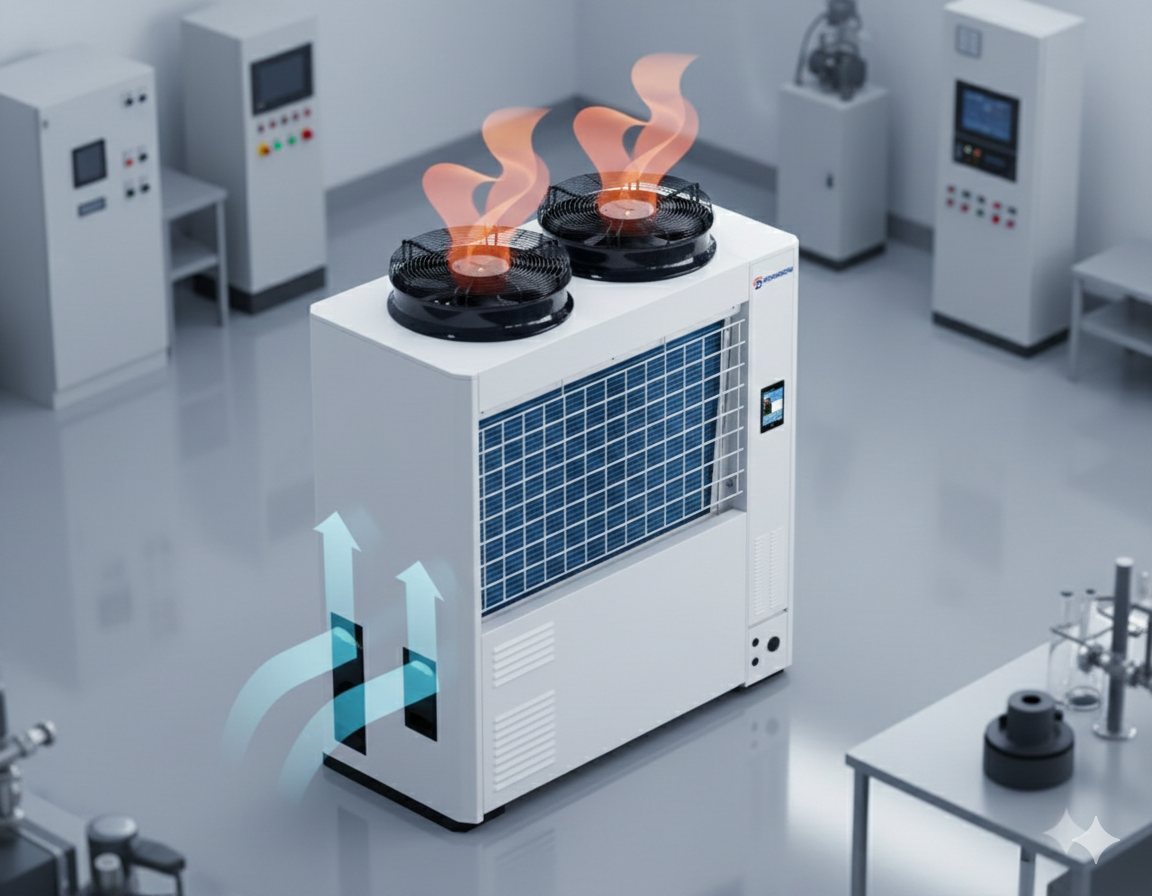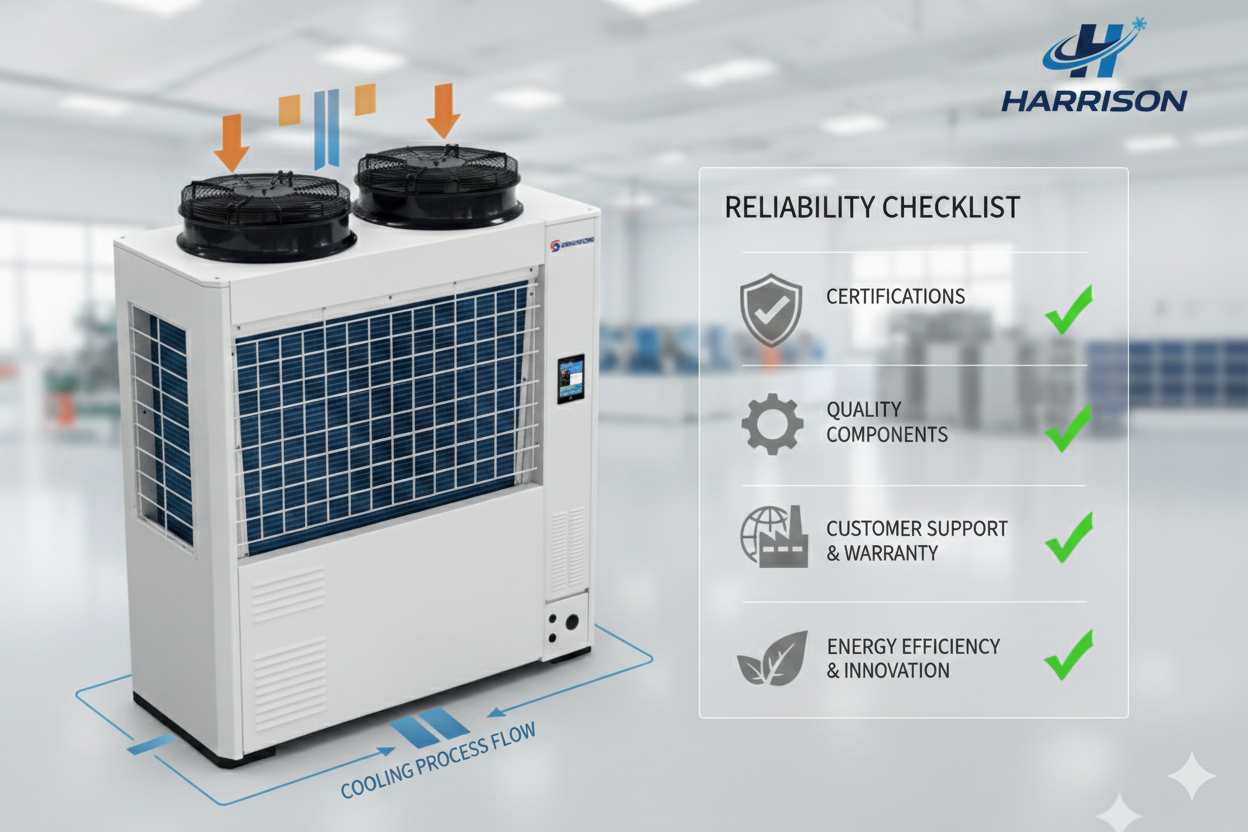
📘 1. Definition: Split Type Industrial Chillers and Packaged Chillers
Industrial cooling systems are essential in modern manufacturing processes. Many industries such as plastics production, pharmaceutical manufacturing, electronics assembly, and laser processing rely on stable temperature control to ensure equipment reliability and product quality.
Among the most common cooling Solutions used today are split type industrial chillers and packaged industrial chiller units. While both systems perform the same fundamental task of removing heat from industrial processes, their structure, installation method, and operational characteristics differ significantly.
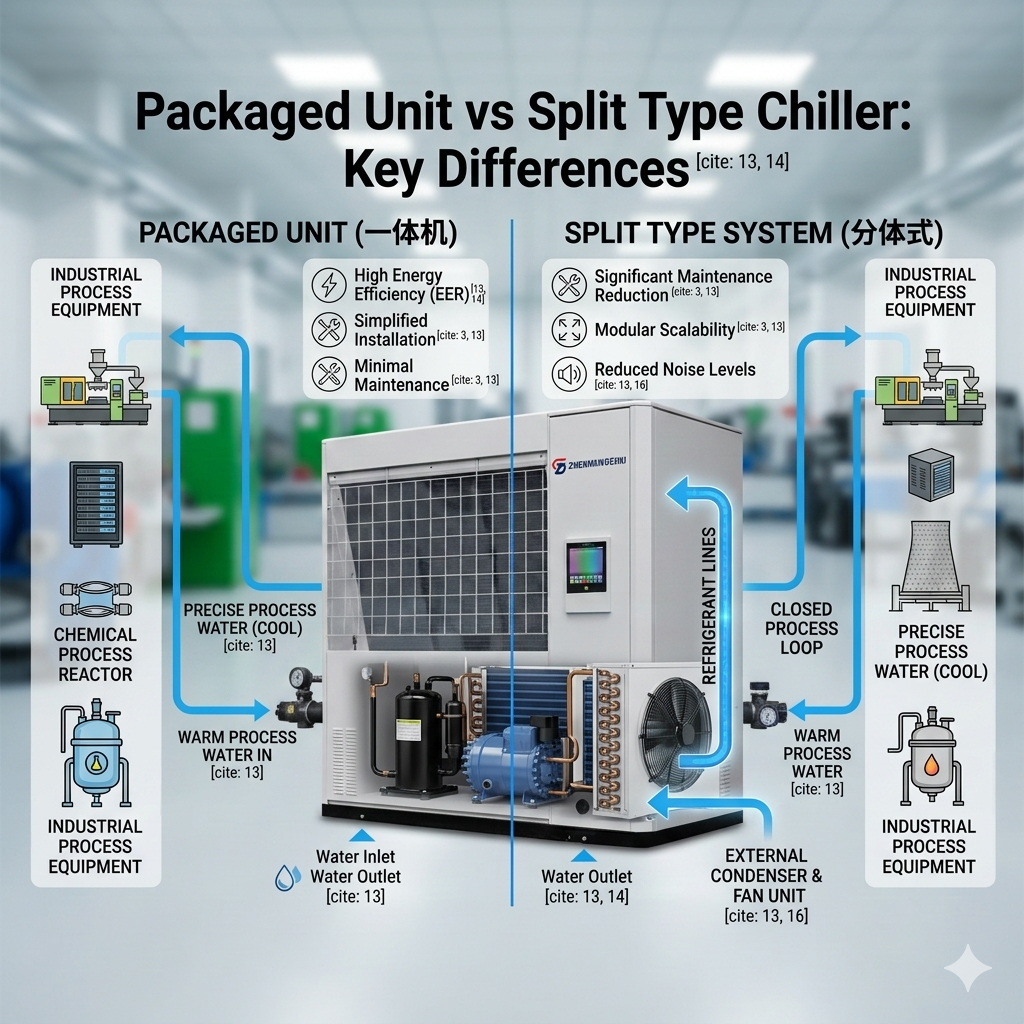
Split type industrial chillers consist of multiple separated components. Typically, the system includes:
- ⚙️ Indoor unit containing compressor and evaporator
- ⚙️ Outdoor condenser unit
- ⚙️ Refrigerant piping connecting both units
This configuration allows heat to be dissipated outside the factory building, which helps reduce indoor temperature and noise levels.
In contrast, packaged industrial chillers integrate all key components into a single cabinet. These components usually include:
- ⚙️ Compressor
- ⚙️ Evaporator
- ⚙️ Condenser
- ⚙️ Circulating pump
- ⚙️ Control system
Because the system is fully assembled at the factory, packaged chillers are often referred to as plug-and-play cooling systems. They require minimal installation and can be deployed quickly.
The key structural difference is simple:
- Split chillers separate condenser and evaporator sections
- Packaged chillers integrate all components into one unit
🔥 2. Industry Challenges Solved by Industrial Chillers
1️⃣ Excessive Heat in Industrial Processes
Many industrial processes generate large amounts of heat during operation. Examples include:
- Plastic injection molding machines
- Laser cutting equipment
- CNC machining centers
- Chemical reactors
If this heat is not removed efficiently, it can cause equipment overheating, production instability, and reduced product quality.
Industrial chillers maintain stable temperatures by continuously circulating chilled water through production equipment.
2️⃣ Limited Space in Industrial Facilities
Factory floor space is often limited, especially in high-density manufacturing environments.
Split type chillers provide a major advantage by placing the condenser outdoors, reducing the amount of equipment inside the production area.
Packaged chillers solve this challenge by offering compact integrated designs that occupy minimal installation space.
3️⃣ High Energy Consumption
Cooling systems typically run for long hours, making them one of the largest energy consumers in industrial facilities.
Modern industrial chillers reduce energy usage through technologies such as:
- ⚡ Variable-speed compressors
- ⚡ High-efficiency heat exchangers
- ⚡ Electronic expansion valves
- ⚡ Intelligent energy control systems
These technologies allow the system to automatically adjust cooling capacity based on real-time load demand.
4️⃣ Complex Installation and Maintenance
Traditional cooling systems often require complicated installation procedures and large engineering projects.
Packaged chillers simplify installation because they are factory-assembled.
Split chillers provide flexible installation layouts, especially for factories with complex building structures.
5️⃣ Environmental Sustainability Requirements
Industries are facing increasing pressure to reduce environmental impact and improve energy efficiency.
Modern chiller systems support sustainability by using:
- 🌱 Energy-efficient compressors
- 🌱 Smart load management systems
- 🌱 Low environmental impact refrigerants
⚙️ 3. Working Principle of Industrial Chiller Systems
Both split type chillers and packaged chillers operate using the vapor compression refrigeration cycle, which is the most widely used cooling technology in industrial applications.
Step 1: Heat Absorption
The cooling cycle begins in the evaporator. Process water flows through the evaporator and absorbs heat from industrial equipment. The refrigerant inside the evaporator absorbs this heat and evaporates into vapor.
Step 2: Compression
The compressor compresses the refrigerant vapor, increasing both its pressure and temperature.
Step 3: Heat Dissipation
The high-temperature refrigerant gas enters the condenser where heat is released. In split systems the condenser is located outdoors, while in packaged systems it is integrated into the main unit.
Step 4: Expansion
The expansion valve reduces the refrigerant pressure and temperature before it returns to the evaporator to repeat the cooling cycle.
This continuous refrigeration cycle ensures stable cooling performance for industrial equipment.
🏭 4. Industrial Application Case Studies
Plastic Injection Molding Factory
- Improved mold temperature stability
- Reduced product defects
- Lower indoor factory temperature
Laser Cutting Equipment Manufacturer
- Temperature stability within ±0.5°C
- Higher cutting precision
- Reduced equipment downtime
Chemical Processing Plant
- Flexible modular cooling capacity
- Improved production safety
- Lower maintenance costs
📊 5. Comparison with Traditional Cooling Systems
| Feature | Split Chiller | Packaged Chiller | Traditional Cooling Tower |
|---|---|---|---|
| Installation Flexibility | High | Medium | Low |
| Energy Efficiency | High | High | Medium |
| Smart Control | Advanced | Advanced | Limited |
| Maintenance | Medium | Low | High |
| Environmental Impact | Low | Low | Higher |
❓ 6. Frequently Asked Questions
- What is the main difference between split and packaged chillers?
Split chillers separate the condenser and evaporator, while packaged chillers integrate all components into one unit. - Which system is easier to install?
Packaged chillers generally require less installation work. - Are split chillers quieter?
Yes, because the condenser is located outdoors. - Which system is better for small factories?
Packaged chillers are usually more suitable due to their compact design. - How long do industrial chillers last?
Most industrial chillers have a lifespan of 15–20 years. - Do chillers support smart monitoring?
Yes, modern chillers support PLC and remote monitoring systems. - Are industrial chillers energy efficient?
Modern systems use variable-speed technology to improve energy efficiency. - Which industries use industrial chillers?
Plastics, electronics manufacturing, chemical processing, pharmaceuticals, and laser equipment industries.
✅ 7. Conclusion
Both split type industrial chillers and packaged chiller units are reliable cooling solutions for modern manufacturing facilities.
Split chillers offer advantages such as flexible installation and reduced indoor heat, while packaged chillers provide compact design and simplified installation.
When selecting an industrial cooling system, companies should consider:
- ✔ Facility layout
- ✔ Cooling capacity requirements
- ✔ Energy efficiency goals
- ✔ Installation conditions
- ✔ Long-term operating costs
Choosing the right chiller system helps improve operational efficiency, reduce energy consumption, and ensure stable industrial production.