1. Definition: What Are magnetic bearing chillers?
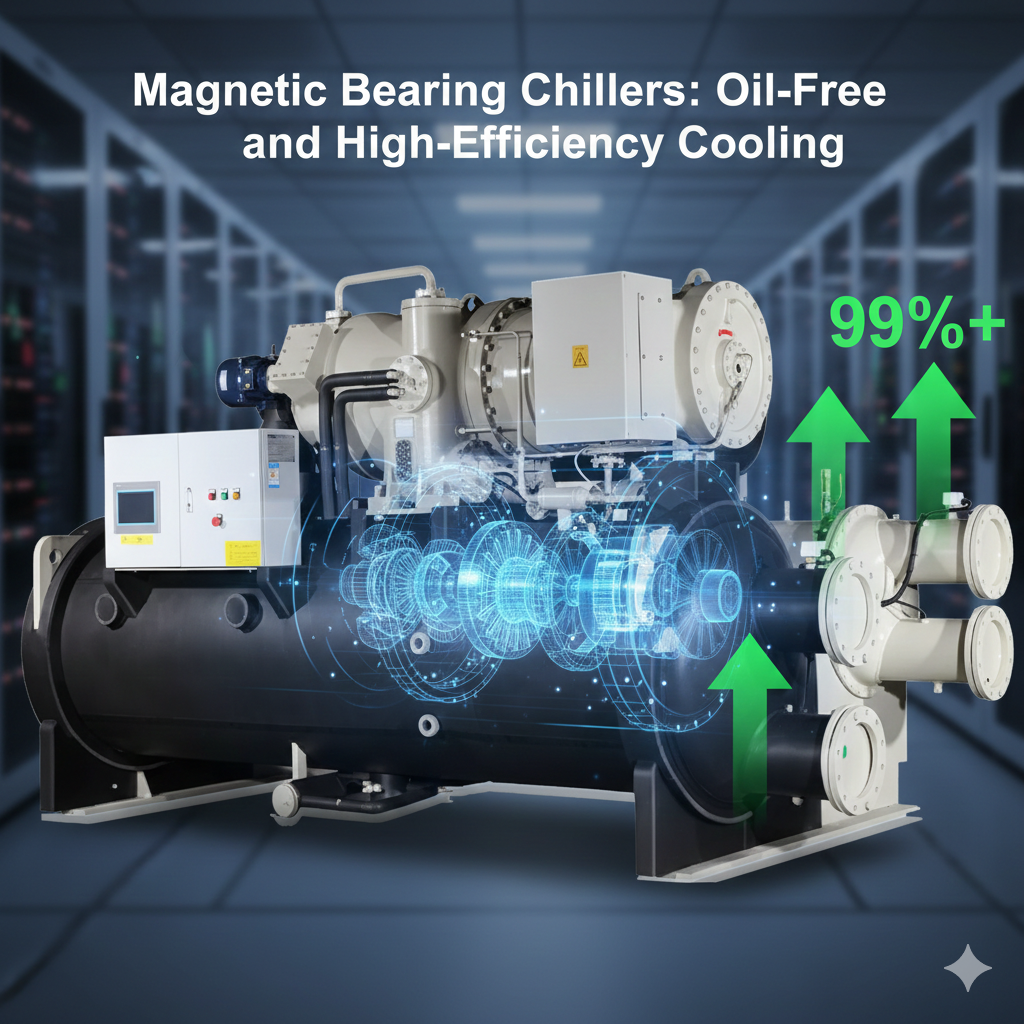
Magnetic bearing chillers are advanced industrial cooling systems that utilize active magnetic bearing (AMB) technology to support and control the rotation of the compressor shaft without any physical contact or lubricating oil.
Unlike traditional chillers that rely on mechanical bearings and oil lubrication, magnetic bearing chillers achieve shaft levitation through precisely controlled electromagnetic fields, eliminating friction, wear, and oil contamination.
At the core of the system is a high-speed centrifugal compressor suspended entirely by magnetic forces. Integrated sensors and digital controllers adjust magnetic fields thousands of times per second to maintain optimal shaft alignment.
✔ Oil-free operation
✔ Ultra-low friction
✔ High precision temperature control
✔ Long service life
2. Industry Pain Points Solved by Magnetic Bearing Chillers
2.1 High Energy Consumption at Partial Load
Conventional chillers perform efficiently only near full load, while real-world operation is dominated by 30–70% part-load conditions. Mechanical friction and oil circulation losses significantly reduce efficiency.
Magnetic bearing chillers deliver industry-leading IPLV performance by eliminating friction losses and using variable-speed control.
2.2 Oil-Related Efficiency Loss and Maintenance
Lubricating oil contaminates heat exchangers, reducing thermal efficiency and increasing maintenance frequency.
- No oil pumps or heaters
- No oil fouling of heat exchangers
- Stable efficiency over system lifetime
2.3 Mechanical Wear, Noise, and Vibration
Mechanical bearings generate vibration and noise due to physical contact.
Magnetic levitation eliminates contact, resulting in near-silent operation and minimal vibration.
2.4 Environmental and Sustainability Pressure
Rising energy costs and carbon regulations demand more sustainable cooling Solutions.
♻ Lower CO₂ emissions
♻ Compatible with low-GWP refrigerants
♻ Supports green building certifications
3. Working Principle of Magnetic Bearing Chillers
3.1 Active Magnetic Bearing Technology
Electromagnets suspend the compressor shaft in mid-air. Position sensors continuously monitor shaft movement and transmit signals to a high-speed controller that dynamically adjusts magnetic forces.
3.2 Oil-Free Centrifugal Compression
The levitated shaft drives a centrifugal impeller that compresses refrigerant vapor efficiently without oil contamination.
3.3 Variable-Speed Drive (VSD)
Integrated VSD enables precise capacity modulation and ultra-efficient low-load operation, even below 10% cooling demand.
3.4 Intelligent Digital Control
Advanced control systems provide real-time diagnostics, predictive maintenance, and seamless BMS integration.
4. Application Case Studies
Data Center: 35% reduction in cooling energy consumption and improved system redundancy.
Pharmaceutical Plant: ±0.3°C temperature stability with GMP compliance.
Commercial High-Rise: Achieved LEED certification and reduced operational noise.
Semiconductor Manufacturing: Continuous, stable cooling for precision processes.
5. Comparison with Traditional Cooling Technologies
| Criteria | Magnetic Bearing Chillers | Traditional Chillers |
|---|---|---|
| Lubrication | Oil-Free | Oil-Based |
| energy efficiency | Very High | Moderate |
| Noise & Vibration | Extremely Low | Higher |
| Maintenance | Minimal | Frequent |
| Environmental Impact | Low | Higher |
| System Intelligence | Advanced Digital Control | Limited |
6. Frequently Asked Questions (FAQ)
Q1: Why are magnetic bearing chillers oil-free?
Because electromagnetic levitation replaces mechanical bearings.
Q2: Are they reliable?
Yes, fewer mechanical components improve reliability.
Q3: Is maintenance required?
Minimal maintenance, no oil service.
Q4: Suitable for industrial use?
Yes, widely used in critical industrial applications.
Q5: Energy efficiency?
20–40% annual energy savings.
Q6: Environmentally friendly?
Yes, lower emissions and green refrigerants.
Q7: Initial cost?
Higher upfront, lower lifecycle cost.
Q8: Smart system compatible?
Fully compatible with BMS and IoT platforms.
7. Conclusion
Magnetic bearing chillers represent the future of industrial cooling by combining oil-free design, intelligent control, and exceptional energy efficiency.
For organizations pursuing long-term sustainability, reduced operating costs, and advanced thermal management, magnetic bearing chillers are a strategic investment in next-generation cooling technology.