1. Definition: What Is an Air Cooled Chiller?
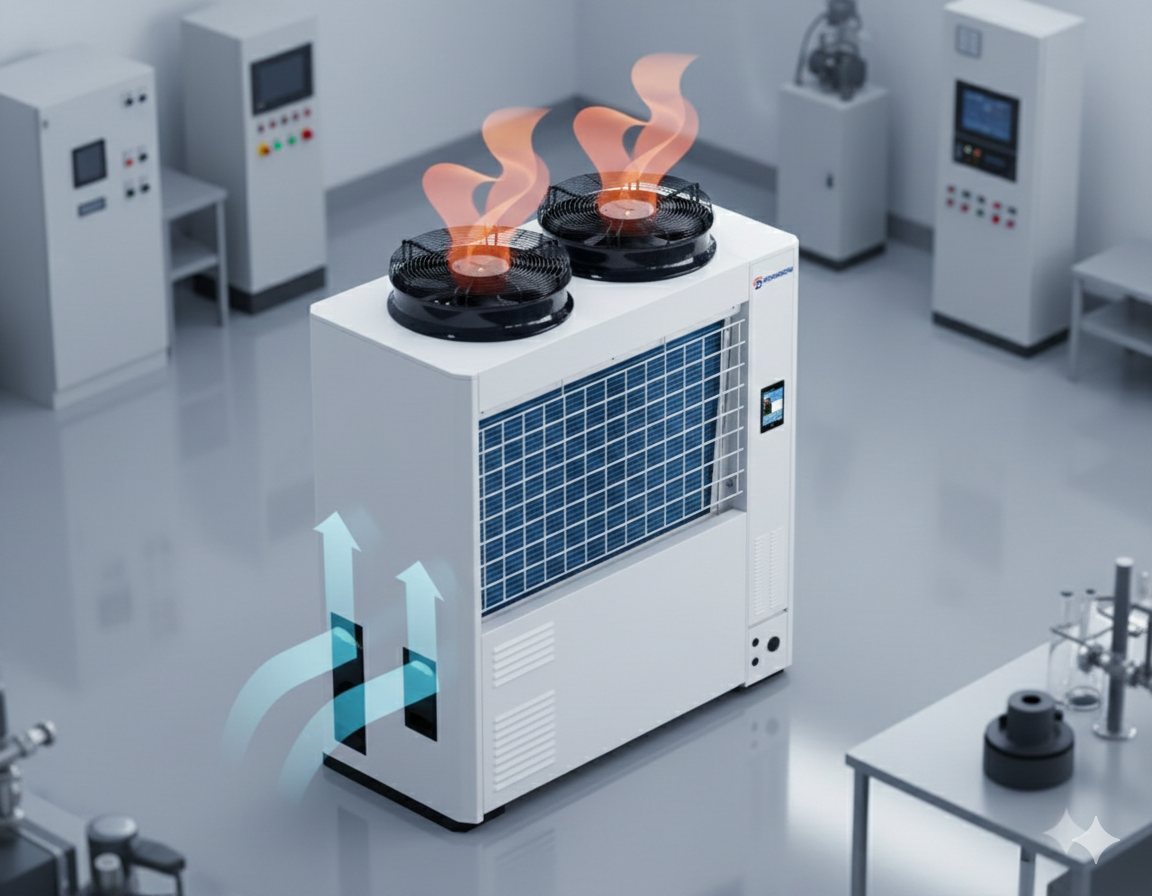
An air cooled chiller is an industrial cooling system that removes heat from a process or facility and releases it directly into the surrounding air through a condenser and high-efficiency fans.
Unlike water-cooled chillers, air cooled chillers do not require cooling towers, condenser water pumps, or complex water treatment systems. This makes them a practical and sustainable cooling solution for modern industrial and commercial environments.
By combining mechanical refrigeration, intelligent controls, and optimized airflow design, air cooled chillers deliver stable cooling performance with reduced infrastructure complexity.
2. Industry Pain Points Solved by Air Cooled Chillers
- Water scarcity and high water costs: Air cooled chillers eliminate cooling towers and water consumption.
- Complex installation: Traditional systems require extensive piping and infrastructure.
- Poor energy efficiency at partial load: Older cooling methods lack intelligent load control.
- High maintenance requirements: Water systems suffer from scaling, corrosion, and biological growth.
- Environmental compliance pressure: Increasing demand for water-saving and energy-efficient Solutions.
Air cooled chillers solve these challenges through simplified system design, intelligent control logic, and environmentally responsible operation.
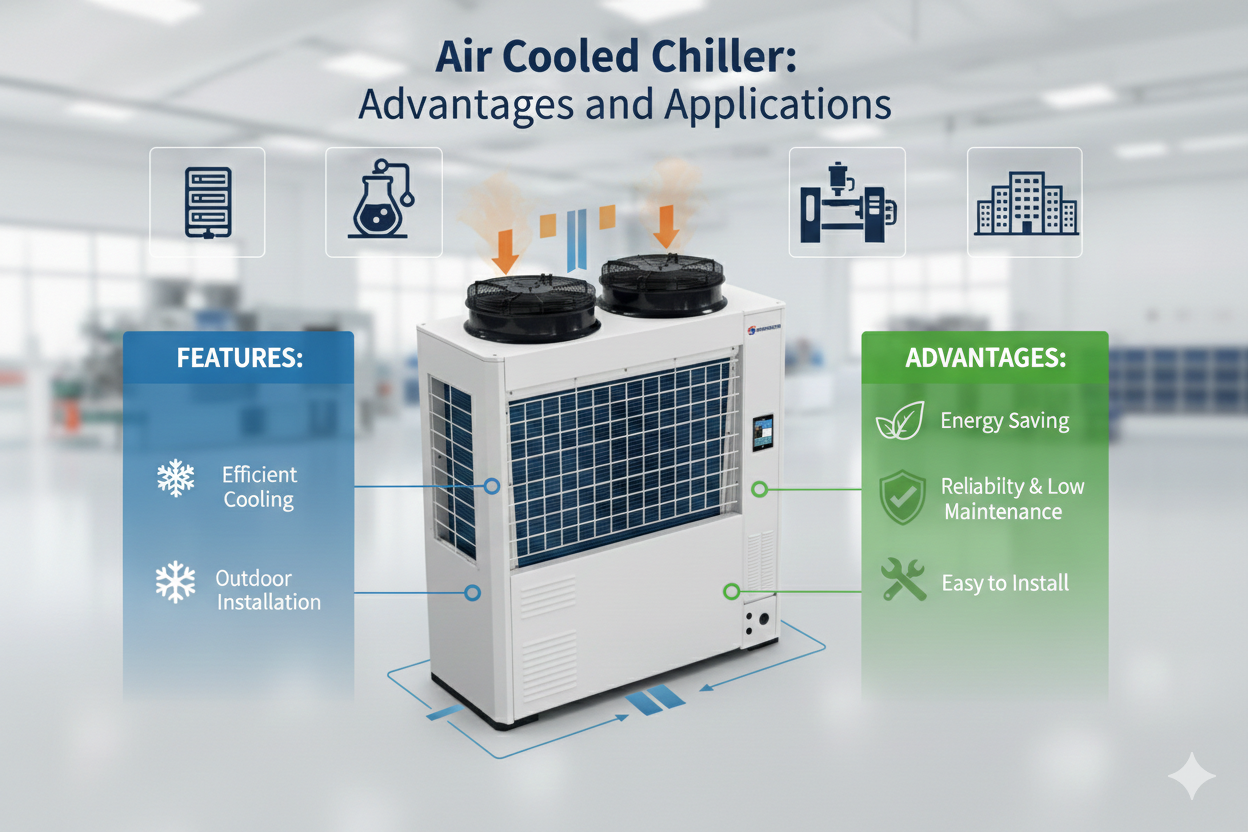 Air cooled cooling system" width="1248" height="832" />
3. Working Principle of an Air Cooled Chiller
Step 1: Heat Absorption in the Evaporator
Process fluid absorbs heat from industrial equipment and transfers it to the refrigerant inside the evaporator.
Step 2: Refrigerant Compression
The compressor raises the pressure and temperature of the refrigerant vapor, preparing it for heat rejection.
Step 3: Air-Based Heat Rejection
High-efficiency fans force ambient air across the condenser coils, releasing heat into the atmosphere.
Step 4: Expansion and Cooling
The refrigerant passes through an expansion valve, reducing temperature before returning to the evaporator.
Step 5: Intelligent System Control
Advanced controllers continuously monitor temperature, pressure, and energy consumption to optimize performance.
4. Case Study: Air Cooled Chiller in Industrial Manufacturing
Application Background: A precision manufacturing plant required reliable cooling for CNC machines while facing strict water usage limits.
Implemented Solution:
- Air cooled industrial chiller
- Variable-speed compressor technology
- PLC-based intelligent control system
Operational Results:
- Zero water consumption achieved
- Energy efficiency improved by approximately 30%
- Maintenance costs significantly reduced
- Improved system uptime and process stability
5. Air Cooled Chillers vs Traditional Cooling Methods
| Evaluation Aspect | Air Cooled Chiller | Traditional Cooling |
|---|---|---|
| Cooling Medium | Ambient air | Water-based systems |
| Water Consumption | None | High |
| Energy Efficiency | High with smart control | Low at partial load |
| Environmental Impact | Water-saving, eco refrigerants | High water and chemical usage |
| System Intelligence | Advanced monitoring & automation | Limited automation |
| Maintenance | Simple and low-cost | Complex and frequent |
6. FAQ: Air Cooled Chillers
Q1: What industries use air cooled chillers?
Manufacturing, plastics, pharmaceuticals, food processing, laboratories, and OEM equipment.
Q2: Are air cooled chillers suitable for hot climates?
Yes, modern designs support high ambient temperatures.
Q3: How energy-efficient are they?
Very efficient with variable-speed and intelligent control.
Q4: Do they require cooling towers?
No, cooling towers are not needed.
Q5: What maintenance is required?
Fan inspection, coil cleaning, and routine checks.
Q6: Can air cooled chillers be customized?
Yes, for capacity, control, and integration.
Q7: Are they environmentally friendly?
Yes, due to water savings and low-GWP refrigerants.
Q8: What is the typical lifespan?
15–20 years with proper maintenance.
7. Conclusion
Air cooled chillers offer a smart, energy-efficient, and environmentally responsible cooling solution for modern industrial applications.
By eliminating water dependency, simplifying installation, and integrating intelligent control systems, they provide long-term operational stability and reduced total cost of ownership.
For industries focused on sustainability, efficiency, and reliability, air cooled chillers remain a future-ready cooling technology.