1. Definition: What Is an Industrial Chiller?
An industrial chiller is a specialized cooling system designed to remove heat from industrial processes, equipment, or fluids and maintain a stable, controlled temperature during continuous operation.
Unlike comfort air conditioning systems, industrial chillers are engineered for precision, durability, and 24/7 reliability in demanding environments such as manufacturing plants, laboratories, data centers, energy facilities, and OEM equipment.
Modern industrial chillers integrate advanced compressors, high-efficiency heat exchangers, smart controllers, and environmentally friendly refrigerants, enabling precise temperature control, reduced energy consumption, and improved system intelligence.
2. Industry Pain Points Solved by Industrial Chillers
- Process instability: Temperature fluctuations can cause product defects and scrap.
- Excessive energy consumption: Traditional cooling methods waste electricity.
- Equipment overheating: Shortens machinery lifespan.
- Environmental pressure: High water and energy usage increases carbon footprint.
- Lack of system intelligence: Old systems cannot optimize or detect faults.
Industrial chillers address these challenges through closed-loop temperature control, energy-efficient components, and intelligent monitoring.
3. How an Industrial Chiller Works
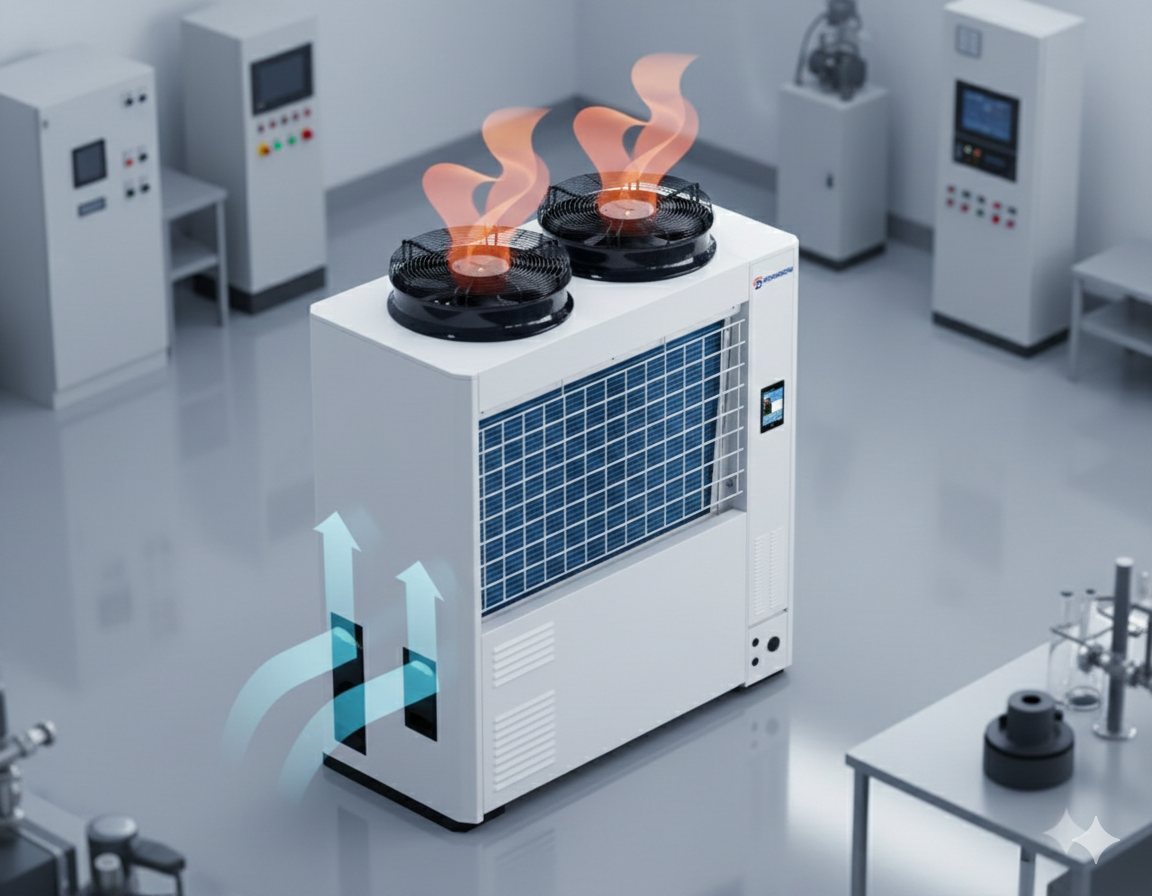
Step 1: Heat Absorption from the Process
Process fluid absorbs heat and flows into the evaporator. Refrigerant absorbs the heat and evaporates.
Step 2: Compression and Energy Upgrade
Low-pressure refrigerant vapor enters the compressor, increasing pressure and temperature for heat rejection.
Step 3: Heat Rejection to the Environment
Refrigerant releases heat to air or water in the condenser and condenses back to liquid.
Step 4: Expansion and Cycle Reset
The refrigerant passes through an expansion valve to reduce pressure and temperature before returning to the evaporator.
Step 5: Intelligent Control
Sensors and smart controllers adjust compressor speed, pump flow, and fan operation to maintain precise temperature while optimizing energy usage.
4. Industrial Chiller Case Study
Case Background: A plastics manufacturer suffered inconsistent product quality due to unstable mold temperatures.
Solution: High-efficiency industrial water chiller with closed-loop temperature control and intelligent monitoring.
Results:
- Temperature stability improved from ±3°C to ±0.5°C
- Scrap rate reduced by over 30%
- Energy consumption decreased by ~40%
- Equipment downtime significantly reduced
5. Comparison: Industrial Chillers vs Traditional Cooling Methods
| Comparison Factor | Industrial Chiller | Traditional Cooling |
|---|---|---|
| Temperature Control | High precision, closed-loop | Poor or uncontrolled |
| energy efficiency | Optimized, load-matched | High energy waste |
| Intelligence | Smart controls, monitoring | Minimal or none |
| Environmental Impact | Low water use, eco refrigerants | High water & energy use |
| Operating Cost | Low long-term cost | High long-term cost |
| System Reliability | Designed for 24/7 operation | Limited reliability |
6. FAQ: Industrial Chillers
Q1: What industries use industrial chillers?
Manufacturing, plastics, chemicals, food & beverage, pharmaceuticals, electronics, and data centers.
Q2: What temperature range can industrial chillers control?
Typically from below 0°C to over 30°C.
Q3: Are industrial chillers energy efficient?
Yes, modern variable-speed and intelligent systems optimize energy consumption.
Q4: Air-cooled vs water-cooled?
Air-cooled reject heat to air; water-cooled use water for higher efficiency.
Q5: How long do chillers last?
With maintenance, 15–25 years.
Q6: Can chillers be customized?
Yes, for process requirements and installation constraints.
Q7: Are chillers eco-friendly?
Modern chillers use low-GWP refrigerants and save energy and water.
Q8: Is remote monitoring possible?
Most modern chillers support remote diagnostics and monitoring protocols.
7. Conclusion
Industrial chillers are critical for stable, efficient, and sustainable industrial operations. They provide precise temperature control, energy savings, equipment protection, and intelligent system management.
For modern industries pursuing efficiency, quality, and low environmental impact, industrial chillers are an essential technology for long-term operational success.