Definition of Industrial-Grade Micro High-temperature heat pump Temperature Control Modules
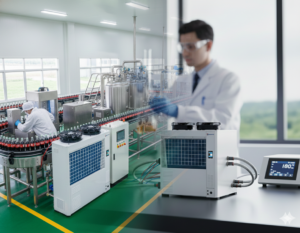
An industrial-grade micro high-temperature heat pump temperature control module is a highly integrated thermal energy control device developed for industrial production lines, laboratories, and precision manufacturing scenarios. Its core function is to use an electrically driven heat pump cycle to upgrade ambient waste heat, process residual heat, or other low-grade heat sources to a controllable high-temperature range of 65–90°C. The system delivers stable, adjustable, and continuously monitored thermal media to end-use points in a modular form, supporting heating, constant temperature control, drying, reaction temperature regulation, and overall thermal process management.
Core Industry Pain Points Addressed by Industrial-Grade Micro High-Temperature Heat Pump Temperature Control Modules
- Low energy efficiency and High Operating Costs of Traditional Heating Methods
Electric heating, gas-fired boilers, and steam systems exhibit low efficiency in the medium-to-high temperature range, resulting in continuously rising unit heat costs. - Insufficient Temperature Control Accuracy Affecting Process Stability
Most traditional heat source systems suffer from slow response and large temperature fluctuations, making them unsuitable for precision processes and experimental applications. - Large Equipment Footprint Incompatible with Space-Constrained Environments
Laboratories, cleanrooms, and modular production lines cannot accommodate large boilers or thermal oil systems. - High Safety and Compliance Risks
Combustion-based equipment introduces open flames, exhaust emissions, regulatory complexity, and safety risks in research and enclosed environments. - Difficulty in Achieving Zoned Heating and Independent Control
Single heat source systems cannot satisfy differentiated temperature requirements across multiple workstations and processes. - Significant Waste of Residual Heat Resources
Cooling water heat, condensation heat, and exhaust heat are often not recovered effectively, resulting in low overall system efficiency. - Insufficient Digitalization and Intelligence Level
Traditional systems struggle to integrate deeply with PLC, MES, and laboratory management systems. - Poor Scalability for Future Capacity or Experimental Upgrades
High initial investment and costly retrofitting limit long-term adaptability.
Working Principle of Industrial-Grade Micro High-Temperature Heat Pump Temperature Control Modules
Step 1: Low-Grade Heat Source Collection and Integration
The system captures initial thermal energy from ambient air, cooling water loops, equipment condensation heat, or other heat sources in the 30–70°C range. In the absence of waste heat, the system operates directly through electrical input.
Step 2: High-Temperature Heat Pump Compression and Energy Level Upgrading
Using high-temperature dedicated compressors and refrigerant circulation, low-grade thermal energy is upgraded to an industrially usable temperature range of 65–90°C.
Step 3: Modular Heat Exchange and Thermal Medium Output
Heat is transferred through plate heat exchangers or jacket-type interfaces to hot water or other thermal media, which are then stably delivered to terminal equipment.
Step 4: Precision Temperature Control and Intelligent Regulation
Integrated temperature sensors and PID / PLC control logic enable dynamic temperature control accuracy within ±1°C.
Step 5: Multi-Module Parallel Operation and System-Level Energy Optimization
Multiple industrial-grade micro high-temperature heat pump temperature control modules can operate in parallel, forming redundant, zoned, and energy-recycling closed-loop systems.
Product Specifications of Industrial-Grade Micro High-Temperature Heat Pump Temperature Control Modules
| Item | Premium Model ZMZ-2HTCR-43 | Standard Model ZMZ-2HTCR |
|---|---|---|
| Performance Label (Winter) | Winter | Winter |
| Standard Heating Capacity | 84.3 kW | 77.4 kW |
| Power Consumption (50Hz/60Hz) | 25.6 / 25.7 kW | 25.1 / 25.2 kW |
| Annual Heating Efficiency (50Hz/60Hz) | 3.9 / 3.9 | 3.8 / 3.8 |
| Water Inlet Temperature Range | 5–65°C | 5–65°C |
| Water Outlet Temperature Range | 65–90°C | 65–90°C |
| Maximum Water Inlet Flow Rate | 35 L/min | 33 L/min |
| Dimensions | 1250 × 1900 × 2360 mm | 1250 × 1900 × 2085 mm |
| Product Weight (Net/Gross) | 1367 / 1382 kg | 1344 / 1359 kg |
| Operating Ambient Temperature | -15–43°C | -15–43°C |
Application Case of Industrial-Grade Micro High-Temperature Heat Pump Temperature Control Modules
Project Background
A comprehensive research and pilot-scale platform required a stable 70–85°C heat source for multiple experimental workstations, supporting reactor temperature control, sample drying, solvent extraction, and equipment sterilization. The original system relied on decentralized electric heaters and small electric boilers, resulting in high energy consumption, unstable temperatures, and frequent maintenance.
Solution
- Deployment of multiple industrial-grade micro high-temperature heat pump temperature control modules for centralized heat supply
- Recovery of laboratory cooling water waste heat as the primary heat source
- Zoned temperature control via buffer tanks
- Integration with the laboratory control system for remote monitoring
Implementation Results
- Temperature control accuracy improved to ±1°C
- Overall energy consumption reduced by approximately 45%
- Safety risks significantly reduced
- System scalability aligned with experimental expansion
Comparative Analysis with Traditional Heating Methods
| Comparison Dimension | Industrial-Grade Micro High-Temperature Heat Pump Temperature Control Module | Traditional Electric Heating / Boilers |
|---|---|---|
| Energy Efficiency | High | Low |
| Temperature Control Accuracy | High | Medium |
| Safety | High | Low |
| Space Occupancy | Small | Large |
| Modularity | Strong | Weak |
| Intelligence Level | High | Low |
| Carbon Emissions | Low | High |
Application FAQ of Industrial-Grade Micro High-Temperature Heat Pump Temperature Control Modules
- Is it suitable for clean laboratories?
Yes, it operates without combustion and emissions. - Does it support continuous operation?
Yes, it supports stable 24-hour operation. - Can the system be expanded in parallel?
Yes, modular expansion is supported. - What temperature control accuracy can be achieved?
Within ±1°C. - Does it require special maintenance?
Maintenance is simple with long service intervals. - Does it support automatic control systems?
Yes, it supports PLC and MES integration. - Are there water quality requirements?
Softened or treated water is recommended. - What is the typical investment payback period?
Typically 2–4 years.
Authoritative Summary
Through high-efficiency heat pump technology, modular architecture, and intelligent control systems, industrial-grade micro high-temperature heat pump temperature control modules are becoming a key technological pathway for replacing traditional heating methods in industrial production and scientific research. Their comprehensive advantages in energy efficiency, safety, temperature control accuracy, and system scalability provide long-term and sustainable application value.